Picking an office desk sounds simple until you start looking. There are hundreds on the market, the specs all sound similar, and half the advice online is just people trying to sell you a £600 standing desk. Here's what actually matters when you're choosing one, broken down in a way that should make the decision a lot easier.
This guide is aimed at people setting up a home office, a small workspace in a shared room, or a proper dedicated study. The same principles apply either way.
Start with the space, not the desk
Before you look at a single product, measure your room. Sounds obvious, but the number of desks that get returned because they don't fit properly would surprise you.
Measure the wall space where the desk will go, the depth from the wall to wherever you'll place your chair, and the height of any radiators, skirting boards or windows that might get in the way. Pay attention to doorways too if you're buying a larger desk, because if it won't fit through the door as a single piece, check that it's flatpack before you order.
A standard adult desk is usually between 100 cm and 160 cm wide and around 60 to 75 cm deep. If you're tight on space, there are narrower options from 80 cm upwards, but you'll want to think carefully about monitor depth. A 27-inch monitor on a 50 cm deep desk sits uncomfortably close to your face.
Match the desk to how you actually work
This is where most people go wrong. They buy the desk that looks good on Instagram rather than the one that suits what they do all day.
If you spend most of your day on video calls, writing emails and editing documents, a basic rectangular desk with one decent monitor's worth of space is plenty. You don't need a giant surface. You need somewhere to put a laptop, a coffee and maybe a notebook.
If you use two monitors, do any kind of creative work, or spread paperwork around while you work, you'll want something bigger. An L-shaped desk is worth considering here, because the corner configuration gives you two working zones without eating the whole room. Our reversible L-shaped desks in particular tend to work well in awkwardly shaped rooms.
And if you're shifting between sitting and standing, that's its own category, which we'll come back to.
Sitting versus standing: honest advice
Standing desks have had a big moment over the last few years, and there's reasonable evidence behind the health claims. Alternating between sitting and standing during the day does seem to reduce back pain and fatigue for a lot of people.
That said, standing desks are more expensive, and a fair number of people who buy one end up keeping it in the sitting position most of the time. If you know you'll use the standing function, the investment pays off. If you're not sure, start with a fixed-height desk and see how you get on.
For those who do want a standing desk, the electric models with memory presets are worth the extra money over the manual crank ones. Switching heights five or six times a day gets tiresome quickly if you have to wind a handle each time. Something like a height range of 72 to 116 cm covers pretty much anyone, and four memory presets means the whole household can use it if you're sharing.
Storage: how much do you actually need?
A desk with drawers sounds practical. Then you spend a month using it and realise you keep three pens and a notebook in there and the rest is empty.
Think honestly about what you need to store at your desk. If you work from digital files and rarely print anything, you probably don't need built-in storage. A clean desk with good cable management will serve you better than a bulky one with drawers full of nothing.
If you do handle paperwork, have stationery you use regularly, or want somewhere to tuck away a printer and cables, then storage matters. Look at desks with a combination of one shallow drawer (for pens, charging cables, the stuff you reach for ten times a day) and one deeper drawer or cupboard (for files, notebooks, a laptop when it's not in use).
Cable management is the underrated feature. A cable tray or even just a few grommets for feeding cables through the surface makes a surprising difference to how the finished setup looks.
Materials and build: what to watch for
Office desks come in roughly three tiers when it comes to materials.
At the budget end, you're looking at particleboard with a laminate or melamine finish. These are perfectly fine for light to moderate use. They'll take a few knocks and spills without showing it, and the modern finishes look decent. Just don't expect them to handle being dismantled and reassembled multiple times.
In the middle, you get engineered wood with better laminates, solid wood legs, or MDF with a veneered finish. These feel more substantial and last longer.
At the top end, you're into solid wood, higher-grade metals and desks that genuinely last decades. Worth it if you're setting up permanently and the desk will see daily use for years.
A few things to check regardless of price. Is the weight capacity listed? For a desk you'll put a monitor, laptop and probably a few books on, you want something rated for at least 30 kg. Are the legs properly braced? A wobbly desk is genuinely infuriating to work at. Does it have adjustable feet for uneven floors? Older UK houses rarely have perfectly level floors, and unadjustable desks rock.
Small spaces: making it work
If you're working from a corner of a bedroom, a narrow hallway nook or a small spare room, compact desks are your friend. Look for depths around 45 to 50 cm and widths of 80 to 100 cm. Wall-mounted folding desks are worth a look if floor space is genuinely tight.
A trick that works well: pick a desk with legs that go all the way to the floor at the back corners rather than one with a solid rear panel. It looks less bulky visually, even if the actual footprint is identical.
Matching the rest of your room
If the desk is going in a dedicated office, you've got more freedom. If it's going in a living room, bedroom or open-plan space, try to pick something that doesn't scream "office furniture" when you're off the clock.
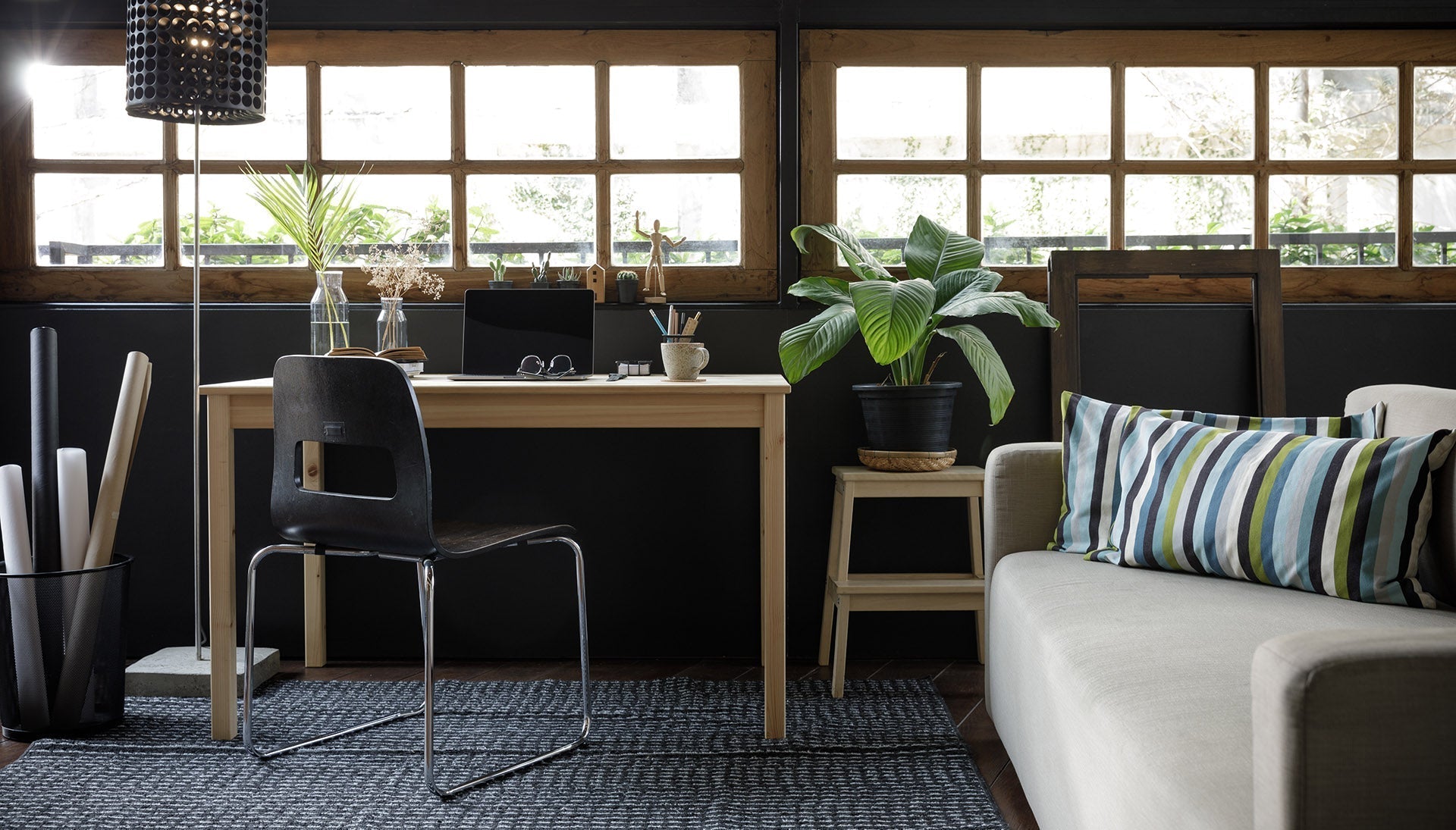
Lighter wood finishes, slim profiles and desks with fabric or rattan details blend in better with living spaces. Black metal and glass looks sharp in a dedicated office but tends to feel cold in a bedroom.
A quick sense check before you buy
Before clicking order, run through this:
Does it fit, with room for a chair to roll back? Is it the right height for your typing posture (roughly 72 to 76 cm for most adults)? Does it have enough surface for what you'll actually put on it, not just what you're using today? Is the build suitable for how often you'll use it? And will you still like looking at it in three years?
If the answer to all five is yes, you've probably found the right one. You can browse the full desks collection or look at the wider home office range if you're setting up from scratch and need a chair too.
All orders come with free delivery to UK mainland addresses (Northern Ireland excluded), dispatched within 3 to 5 working days with full tracking. No hidden fees at checkout. If you're not sure which desk is right for your setup, get in touch and we'll happily point you in the right direction.